
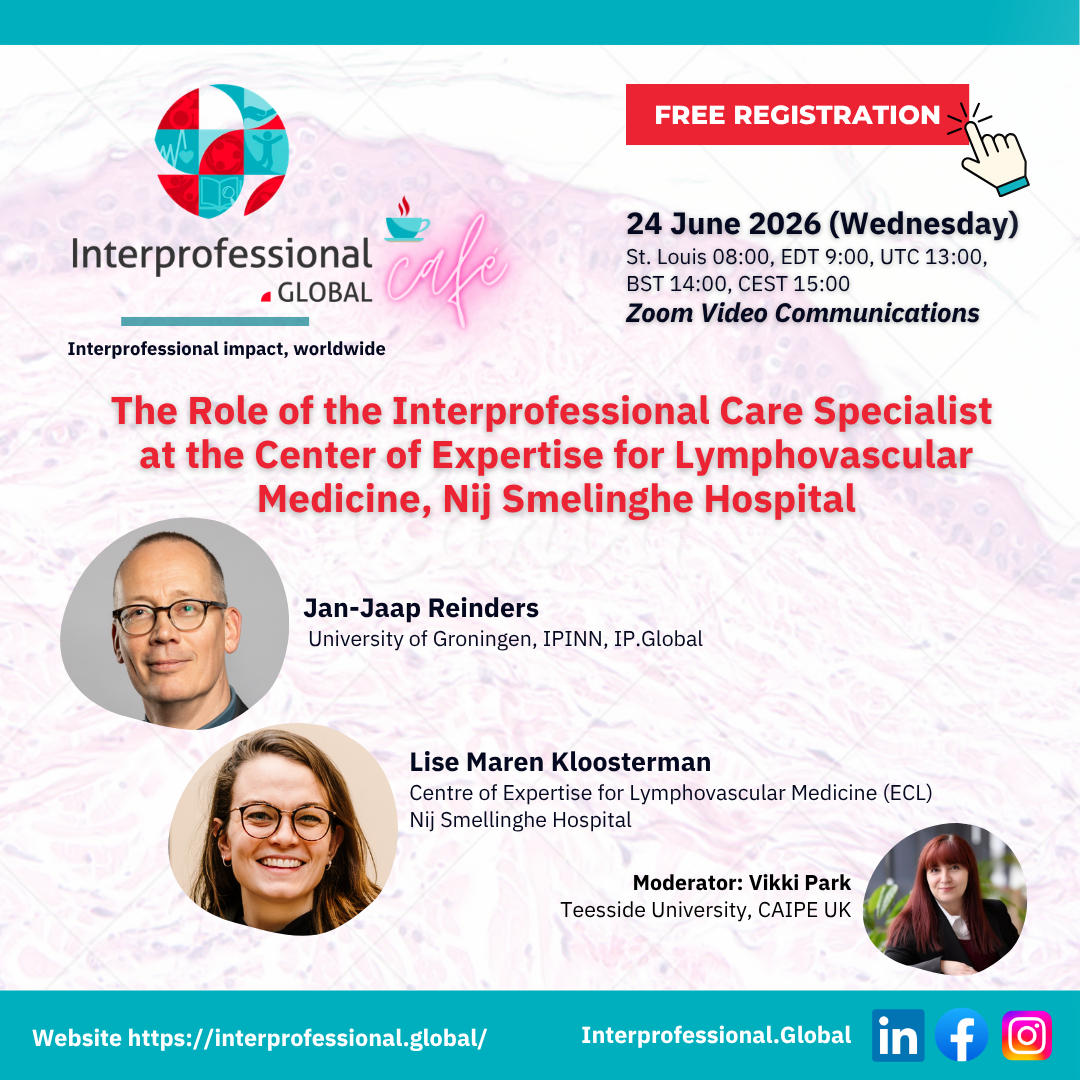
The Role of the Interprofessional Care Specialist at the Center of Expertise for Lymphovascular Medicine, Nij Smelinghe Hospital
24 June 2026
St. Louis 08:00, EDT 9:00, UTC 13:00, BST 14:00, CEST 15:00
Presenters:
- Jan-Jaap Reinders – University of Groningen; IPPIN; IP.Global
- Lise Maren Kloosterman – Centre of Expertise for Lymphovascular Medicine (ECL), Nij Smellinghe Hospital
Moderator:
- Vikki Park – CAIPE; Teesside University
Description:
Dr Jan-Jaap Reinders (Interprofessional Care Specialist) and Dr Lise Maren Kloosterman (Program Manager Innovation & Research) will present the Interprofessional Care Specialist as a new clinical practice role aimed at strengthening interprofessional collaboration. The session will then outline the local context of the Center of Expertise for Lymphovascular Medicine (ECL) within Nij Smellinghe Hospital, where interprofessional teams work in the treatment of complex lymphovascular conditions such as lymphoedema and vascular malformations. It will continue with the strategic handholds of the Interprofessional Care Specialist, informed by EPIT, to activate interprofessional identity in practice. Finally, it will describe the current practice setup and future developments for further scaling across healthcare practice and education.
Abstract:
A new clinical practice role, the Interprofessional Care Specialist, has been introduced at the Center of Expertise for Lymphovascular Medicine at Nij Smellinghe Hospital, a Dutch general hospital. This innovation responds to the increasing complexity of lymphovascular conditions and the need for more integrated interprofessional care delivery.
Lymphovascular conditions are disorders of the lymphatic and vascular systems, including chronic lymphedema, venous insufficiency, lymphatic malformations, and complex wound and fluid regulation problems. These conditions are typically chronic and multifactorial, requiring sustained coordination across medical, nursing, physiotherapy, surgical and other disciplines.
The Center of Expertise provides specialised diagnostics, treatment, and longitudinal follow-up for these patient groups. However, increasing clinical complexity has exposed the limitations of discipline-centred approaches and underscored the need for structured interprofessional alignment.
The Interprofessional Care Specialist functions as a boundary-spanning role that facilitates coordination, shared decision-making, and alignment of care pathways and patient-centred goals. The implementation strategy is explicitly systemic and grounded in the Extended Professional Identity Theory (EPIT), a mid-level psychological theory explaining how interprofessional identity formation develops over time and how interprofessional identity can be activated in specific practice contexts.
Within this framework, EPIT informs both long-term identity development processes and the activation of interprofessional identity in daily clinical practice. The Interprofessional Care Specialist thereby fosters shared meaning-making, mutual role recognition, and collective ownership of care processes, strengthening integrated, high-quality care for patients with lymphovascular conditions.
Author(s) and contact: