
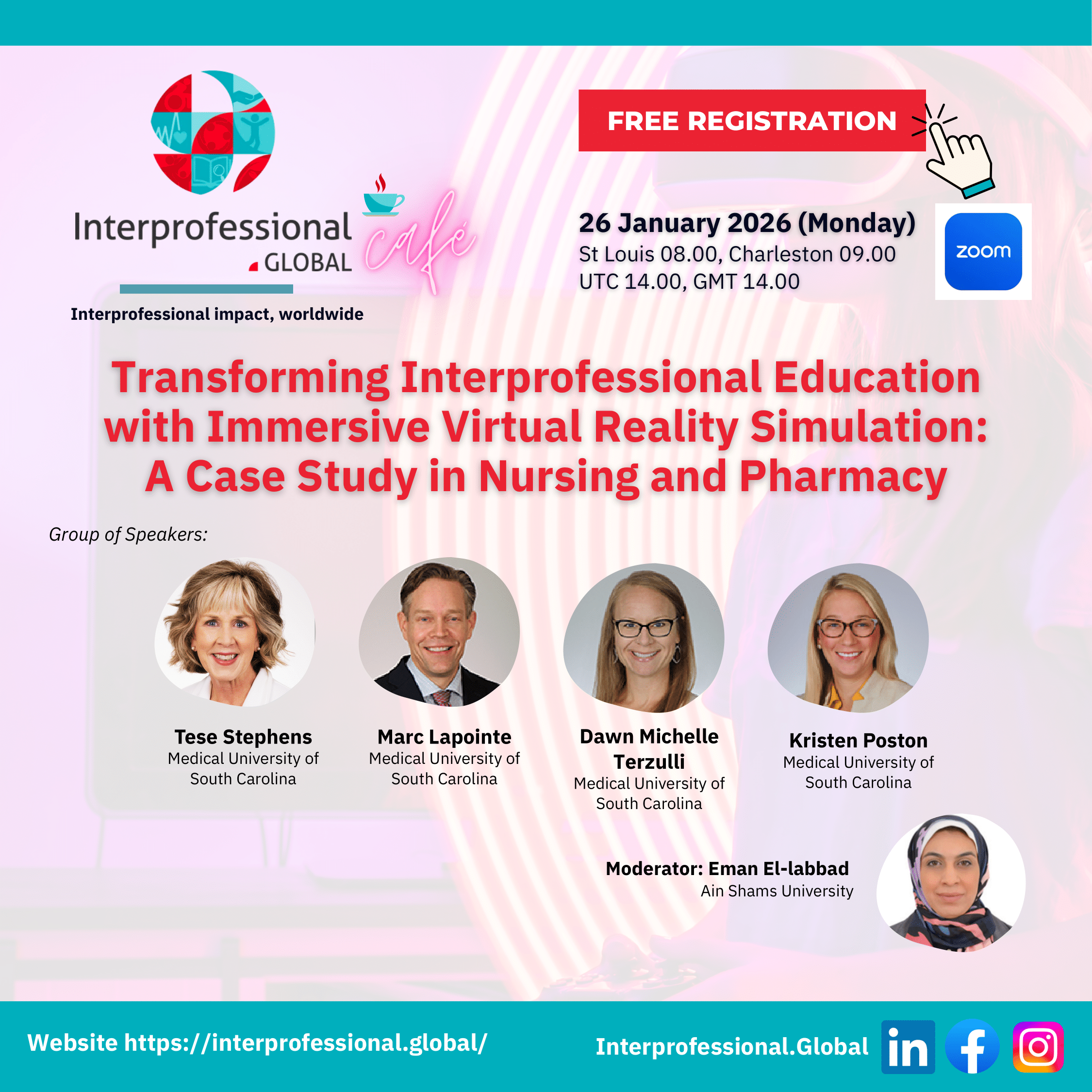
Transforming Interprofessional Education with Immersive Virtual Reality Simulation: A Case Study in Nursing and Pharmacy
26 January 2026
St Louis (CT) 08.00, Charleston (ET) 09.00, UTC 14.00, GMT 14.00
Presenters
- Tese Stephens
- Marc Lapointe
- Dawn Michelle Terzulli
- Kristen Poston
(All presenters are affiliated with the Medical University of South Carolina)
Moderator
- Eman El-labbad (Ain Shams University)
Description:
This presentation will share the results and best practices from an interprofessional pilot project integrating immersive virtual reality simulation (IVRS) into healthcare education for nursing and pharmacy students. The project addressed common barriers to interprofessional simulation, such as scheduling, space, and faculty workload, by leveraging IVRS technology that supports automated analytics, facilitator-free scenario progression, and multiplayer participation across physical locations.
Abstract:
This presentation will share the results and best practices from an interprofessional pilot project integrating immersive virtual reality simulation (IVRS) into healthcare education for nursing and pharmacy students. The project addressed common barriers to interprofessional simulation, such as scheduling, space, and faculty workload, by leveraging IVRS technology that supports automated analytics, facilitator-free scenario progression, and multiplayer participation across physical locations.
Key findings include:
- IVRS significantly increased students’ confidence in providing care within interprofessional teams.
- Automated, objective analytics aligned with curricular objectives enhanced the consistency and educational relevance of learner assessment.
- Repeat scenario attempts following high-quality debriefing led to measurable improvements in teamwork, communication, and clinical performance.
- The flexibility and efficiency of IVRS technology offer a scalable solution to historically labor-intensive interprofessional simulation training.
The session will highlight practical tips for integrating IVRS, including:
- Aligning simulation design with regulatory guidelines (INACSL, HSSOBP, AACN, NCSBN, TeamSTEPPS).
- Using scripted prebrief and debrief documents.
- Selecting software that provides automated analytics and supports independent scenario progression.
- Embedding evidence-based practice guidelines and interprofessional competencies into the simulation experience.
Outcomes:
Participants will gain actionable strategies for designing, implementing, and evaluating interprofessional virtual reality simulations, with a focus on regulatory alignment, curricular integration, and scalable delivery. The presentation will include student feedback, performance data, and lessons learned from overcoming technical and logistical challenges.
Author(s):
- Dawn Terzulli, DNP, RN, PCCN, CHSE (Assistant Professor and Director of Simulation): colkitdm@musc.edu
- Kristen Poston, DNP, APRN, FNP-C, CHSE (Assistant Professor and Assistant Dean for Undergraduate Programs): mcdanikf@musc.edu
- Marc Lapointe, PharmD, BCPS (Professor): lapointe@musc.edu
- Brandi Townsend, BSN, RN (Simulation Coordinator): townsebr@musc.edu
- Teresa Stephens, PhD, MSN, RN, CNE (Professor and Associate Dean for Academics): stephent@musc.edu